Introduction to LightGBMModel
Overview:
The LightGBMModel module in ADS provides different ways of serializing a
trained LightGBM`` model. This example demonstrates how to utilize the
LightGBMModel module to prepare model artifacts, save models into the
model catalog, and then deploy any unsupported model framework.
A model artifact includes the model, metadata about the model, input and output schema, and a script to load the model and make predictions. These model artifacts can be shared among data scientists, tracked for provenance, reproduced, and deployed.
Initiate
LightGBMModel() initiates a LightGBM model instance and accepts the following variables:
estimator: (Callable). Trained LightGBM model using the learning API or the sklearn API.artifact_dir: str. Artifact directory to store the files needed for deployment.properties: (ModelProperties, optional). Defaults to None. TheModelPropertiesobject required to save and deploy model.auth :(Dict, optional). Defaults to None. The default authentication is set using theads.set_authAPI. If you want to override the default, useads.common.auth.api_keysorads.common.auth.resource_principalto create appropriate authentication signer and kwargs required to instantiateIdentityClientobject.
The score.py``file is automatically generated and you don't need to modify it. You can change its contents. For example, add your preferred steps to ``pre_inference and post_inference.
The properties instance of ModelProperties and it has the following predefined fields:
inference_conda_env: strinference_python_version: strtraining_conda_env: strtraining_python_version: strtraining_resource_id: strtraining_script_path: strtraining_id: strcompartment_id: strproject_id: strdeployment_instance_shape: strdeployment_instance_count: intdeployment_bandwidth_mbps: intdeployment_log_group_id: strdeployment_access_log_id: strdeployment_predict_log_id: str
By default,
propertiesis populated from environment variables if it’s not specified. For example, in the notebook session the environment variables for such as project id, compartment id are preset and stored inPROJECT_OCIDandNB_SESSION_COMPARTMENT_OCIDby default. Andpropertiespopulates those variables from the environment variables ,and use the values in functions such as.save()and.deployment()by default. However, you can always explicitly pass the variables into those functions to overwrite the values. For the fields thatpropertieshas, it records the values that you pass into the functions. For example, when you passinference_conda_envinto.prepare(), thenpropertiesrecords this value and you can export it using.to_yaml(). You can reload it using.from_yaml()from any machine, which allows you to reuse the properties in different places.
Summary_status
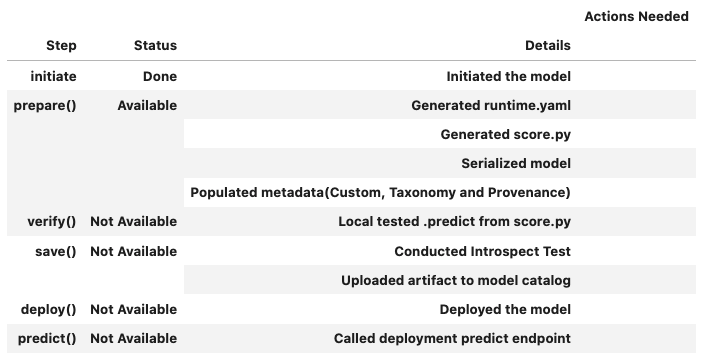
You can call the .summary_status() function any time after the LightGBMModel instance is created.
An example of summary status table is similar to the following after you initiate the model instance. The step column shows all the functions. It shows that the initiate step is completed, and the Details column explains what initiate step did,and that prepare() is now available. The next step is to call prepare().
Prepare
.prepare() takes the following parameters:
inference_conda_env: (str, optional). Defaults to None. Can be either slug or object storage path of the conda pack. You can only pass in slugs if the conda pack is a service pack.inference_python_version: (str, optional). Defaults to None. Python version which will be used in deployment.training_conda_env: (str, optional). Defaults to None. Can be either slug or object storage path of the conda pack. You can only pass in slugs if the conda pack is a service pack.training_python_version: (str, optional). Defaults to None. Python version used during training.model_file_name: (str). Name of the serialized model.as_onnx: (bool, optional). Defaults to False. Whether to serialize as onnx model.initial_types: (List[Tuple], optional). Defaults to None. Each element is a tuple of a variable name and a type. Check this link for more explanation and examples forinitial_types.force_overwrite: (bool, optional). Defaults to False. Whether to overwrite existing files.namespace: (str, optional). Namespace of region. This is used for identifying which region the service pack is from when you pass a slug to inference_conda_env and training_conda_env.use_case_type: str. The use case type of the model. Use it throughUserCaseTypeclass or string provided inUseCaseType. For example,use_case_type=UseCaseType.BINARY_CLASSIFICATIONoruse_case_type="binary_classification". Check withUseCaseTypeclass to see all supported types.X_sample: Union[Dict, str, List, np.ndarray, pd.core.series.Series, pd.core.frame.DataFrame,]. Defaults to None.y_sample: Union[Dict, str, List, pd.Series, np.ndarray]. Defaults to None. A sample of output data that will be used to generate output schema.training_script_path: str. Defaults to None. Training script path.training_id: (str, optional). Defaults to value from environment variables. The training OCID for model. Can be notebook session or job OCID.ignore_pending_changes: bool. Defaults to False. Whether to ignore the pending changes in the git.max_col_num: (int, optional). Defaults toutils.DATA_SCHEMA_MAX_COL_NUM. The maximum column size of the data that allows to auto generate schema.
kwargs:
impute_values: (dict, optional). The dictionary where the key is the column index(or names is accepted for pandas dataframe) and the value is the impute value for the corresponding column.
Notes:
We provide two ways of serializing the models: local method which is supported by lightgbm and onnx method. By default, local method is used and also it is recommended way of serialize the model.
prepare()also takes any variables that skl2onnx.convert_sklearn takes when the estimstor is using sklearn API. If the estimator is using learning API, then kwargs takes any variable that onnxmltools.convert_lightgbm takes.
It will automatically generate the following files.
runtime.yamlscore.pymodel.txtfor learning api,model.joblibfor sklearn api by default. Ifas_onnx=Truethe default file name should bemodel.onnx. However, you can set model file name yourself.input_schema.jsonwhenX_sampleis passed in and the schema is more than 32kb.output_schema.jsonwheny_sampleis passed in and the schema is more than 32kb.hyperparameters.jsonif extracted hyperparameters is more than 32kb.
Verify
.verify() function takes one parameter:
data (Union[Dict, str, List, np.ndarray, pd.core.series.Series, pd.core.frame.DataFrame]). Data used to test if deployment works in local environment.
It is used to test if deployment would work in the local environment. Before saving and deploying the model, it is recommended to call this function to check if load_model and predict function in score.py works. It takes and returns the same data as model deployment predict takes and returns.
In LightGBMModel, data serialization is supported for dictionary, string, list, np.ndarray, pd.core.series.Series, pd.core.frame.DataFrame, which means that user can pass in Pandas DataFrame or Numpy array even though they are not JSON serializable. The reason is that we internally serialize and deserialize the data automatically.
Save
.save() function takes the following parameters:
display_name: (str, optional). Defaults to None. The name of the model.description: (str, optional). Defaults to None. The description of the model.freeform_tags : Dict(str, str). Defaults to None. Freeform tags for the model.defined_tags : (Dict(str, dict(str, object)), optional). Defaults to None. Defined tags for the model.ignore_introspection: (bool, optional). Defaults to None. Determines whether to ignore the result of model introspection or not. If set to True, the save will ignore all model introspection errors.
kwargs:
- project_id: (str, optional). Project OCID. If not specified, the value will be taken either from the environment variables or model properties.
- compartment_id : (str, optional). Compartment OCID. If not specified, the value will be taken either from the environment variables or model properties.
- timeout: (int, optional). Defaults to 10 seconds. The connection timeout in seconds for the client.
It will first reload the score.py and runtime.yaml files from the disk so that any changes made to those files can be picked up. And then, it conducts an instropection test by default. However, you can set ignore_introspection=False to avoid it. Introspection test checks if .deployment() later could have some issues and suggests neccessary actions needed to get them fixed. Lastly, it will upload the artifacts to the model catalog and return a model_id for the saved model.
You can also call .instrospect() to conduct the test any time after .prepare() is called.
Deploy
.deploy() takes the following parameters:
wait_for_completion : (bool, optional). Defaults to True. Flag set for whether to wait for deployment to complete before proceeding.display_name: (str, optional). Defaults to None. The name of the model.description: (str, optional). Defaults to None. The description of the model.deployment_instance_shape: (str, optional). Default toVM.Standard2.1. The shape of the instance used for deployment.deployment_instance_count: (int, optional). Defaults to 1. The number of instance used for deployment.deployment_bandwidth_mbps: (int, optional). Defaults to 10. The bandwidth limit on the load balancer in Mbps.deployment_log_group_id: (str, optional). Defaults to None. The oci logging group id. The access log and predict log share the same log group.deployment_access_log_id: (str, optional). Defaults to None. The access log OCID for the access logs. Link: https://docs.oracle.com/en-us/iaas/data-science/using/model_dep_using_logging.htmdeployment_predict_log_id: (str, optional). Defaults to None. The predict log OCID for the predict logs. Link: https://docs.oracle.com/en-us/iaas/data-science/using/model_dep_using_logging.htm
kwargs:
project_id: (str, optional). Project OCID. If not specified, the value will be taken from the environment variables.compartment_id : (str, optional). Compartment OCID. If not specified, the value will be taken from the environment variables.max_wait_time : (int, optional). Defaults to 1200 seconds. Maximum amount of time to wait in seconds. Negative implies infinite wait time.poll_interval : (int, optional). Defaults to 60 seconds. Poll interval in seconds.
It will deploy the model. In order to make deployment more smooth, we suggest using exactly the same conda environments for both local development and deployment. Discrepancy between the two could cause problems.
You can pass in deployment_log_group_id, deployment_access_log_id and deployment_predict_log_id to enable the logging. Please refer to this logging example for an example on logging. To create a log group, you can reference Logging session.
Predict
.predict() will take one parameter Data expected by the predict API in score.py.
- data (Union[Dict, str, List, np.ndarray, pd.core.series.Series, pd.core.frame.DataFrame]).
.predict()``takes the same data that ``.verify() takes, user has to make sure the data passed and returned by predict in the score.py is json serializable. It passes the data to the model deployment endpoint and calls the predict function in the score.py.
Delete_deployment
.delete_deployment() takes one parameter:
wait_for_completion: (bool, optional). Defaults to False. Whether to wait till completion.
Once you dont need the deployment any more. You can call delete_deployment to delete the current deployment that is attached to this model. Note that each time you call deploy, it will create a new deployment and only the new deployment is attached to this model.
from_model_artifact
.from_model_artifact() allows to load a model from a folder, zip or tar achive files, where the folder/zip/tar files should contain the files such as runtime.yaml, score.py, the serialized model file needed for deployments. It takes the following parameters:
uri: str: The folder path, ZIP file path, or TAR file path. It could contain a seriliazed model(required) as well as any files needed for deployment including: serialized model, runtime.yaml, score.py and etc. The content of the folder will be copied to theartifact_dirfolder.model_file_name: str: The serialized model file name.artifact_dir: str: The artifact directory to store the files needed for deployment.auth: (Dict, optional): Defaults to None. The default authetication is set usingads.set_authAPI. If you need to override the default, use the ads.common.auth.api_keys or ads.common.auth.resource_principal to create appropriate authentication signer and kwargs required to instantiate IdentityClient object.force_overwrite: (bool, optional): Defaults to False. Whether to overwrite existing files or not.properties: (ModelProperties, optional): Defaults to None. ModelProperties object required to save and deploy model.
After this is called, you can call .verify(), .save() and etc.
from_model_catalog
from_model_catalog allows to load a remote model from model catalog using a model id , which should contain the files such as runtime.yaml, score.py, the serialized model file needed for deployments. It takes the following parameters:
model_id: str. The model OCID.model_file_name: (str). The name of the serialized model.artifact_dir: str. The artifact directory to store the files needed for deployment. Will be created if not exists.auth: (Dict, optional). Defaults to None. The default authetication is set usingads.set_authAPI. If you need to override the default, use theads.common.auth.api_keysorads.common.auth.resource_principalto create appropriate authentication signer and kwargs required to instantiate IdentityClient object.force_overwrite: (bool, optional). Defaults to False. Whether to overwrite existing files or not.properties: (ModelProperties, optional). Defaults to None. ModelProperties object required to save and deploy model.
kwargs:
compartment_id : (str, optional). Compartment OCID. If not specified, the value will be taken from the environment variables.timeout : (int, optional). Defaults to 10 seconds. The connection timeout in seconds for the client.
Examples
Create a Lightgbm Estimator
import ads
import lightgbm as lgb
import logging
import numpy as np
import pandas as pd
import os
import tempfile
import warnings

from ads.catalog.model import ModelCatalog
from ads.model.framework.lightgbm_model import LightGBMModel
from shutil import rmtree
from skl2onnx.common.data_types import FloatTensorType
from sklearn.compose import ColumnTransformer
from sklearn.model_selection import train_test_split
from sklearn.pipeline import Pipeline
from sklearn.preprocessing import LabelEncoder, OrdinalEncoder

# Load data
df_path = os.path.join("/", "opt", "notebooks", "ads-examples", "oracle_data", "orcl_attrition.csv")
df = pd.read_csv(df_path)
y = df["Attrition"]
X = df.drop(columns=["Attrition"])

X_train, X_test, y_train, y_test = train_test_split(X, y, test_size=0.1, random_state=42)

# Label encode the y values
le = LabelEncoder()
y_train_transformed = le.fit_transform(y_train)
y_test_transformed = le.transform(y_test)

# Extract numerical columns and categorical columns
categorical_cols = []
numerical_cols = []
for i, col in X.iteritems():
    if col.dtypes == "object":
        categorical_cols.append(col.name)
    else:
        numerical_cols.append(col.name)

categorical_transformer = Pipeline(
    steps=[
        ('encoder', OrdinalEncoder())
    ]
)

# Build a pipeline
preprocessor = ColumnTransformer(
    transformers=[
        ('cat', categorical_transformer, categorical_cols)
    ]
)

preprocessor_pipeline = Pipeline(steps=[('preprocessor', preprocessor)])
preprocessor_pipeline.fit(X_train)
X_train_transformed = preprocessor_pipeline.transform(X_train)
X_test_transformed = preprocessor_pipeline.transform(X_test)

# LightGBM Training API
dtrain = lgb.Dataset(X_train_transformed, label=y_train_transformed)
dtest = lgb.Dataset(X_test_transformed, label=y_test_transformed)

estimator_train = lgb.train(
    params={'num_leaves': 31, 'objective': 'binary', 'metric': 'auc'},
    train_set=dtrain, num_boost_round=10)

# LightGBM Scikit-Learn API
estimator = lgb.LGBMClassifier(
    n_estimators=100, learning_rate=0.01, random_state=42
)
estimator.fit(
    X_train_transformed,
    y_train_transformed,
)
Lightgbm Framework Serialization - Training API
learning_api_model = LightGBMModel(estimator=estimator_train, artifact_dir=tempfile.mkdtemp())
learning_api_model.prepare(
    inference_conda_env="generalml_p37_cpu_v1",
    force_overwrite=True,
)
learning_api_model.verify(X_test_transformed)['prediction'][:10]
learning_api_model.save()
learning_api_model.deploy()
learning_api_model.delete_deployment()
Lightgbm Framework Serialization - Sklearn API
model = LightGBMModel(estimator=estimator, artifact_dir=artifact_dir)
model.prepare(
    inference_conda_env="generalml_p37_cpu_v1",
    training_conda_env="generalml_p37_cpu_v1",
    X_sample=X_train_transformed[:10],
    as_onnx=True,
    force_overwrite=True,
)
model.verify(X_test_transformed[:10])['prediction']
model.save()
model.deploy()
model.predict(X_test_transformed[:10])['prediction']
model.delete_deployment()
Onnx Serialization - Training API
learning_api_model_onnx = LightGBMModel(estimator=estimator_train, artifact_dir=tempfile.mkdtemp())
initial_types = [('input', FloatTensorType(shape=[None, 8]))]
learning_api_model_onnx.prepare(
    inference_conda_env="oci://bucket@namespace/path/to/custom_conda_pack",
    inference_python_version="3.7",
    as_onnx=True,
    force_overwrite=True,
    initial_types=initial_types,
)
learning_api_model_onnx.verify(X_test_transformed[:10].astype("float32"))['prediction']
learning_api_model_onnx.save()
learning_api_model_onnx.deploy()
learning_api_model_onnx.predict(X_test_transformed[:10].astype("float32"))['prediction']
learning_api_model_onnx.delete_deployment()
Onnx Serialization - Sklearn API
sklearn_api_model_onnx = LightGBMModel(estimator=estimator, artifact_dir=tempfile.mkdtemp())
initial_types = [('input', FloatTensorType(shape=[None, 8]))]
sklearn_api_model_onnx.prepare(
    inference_conda_env="oci://license_checker@ociodscdev/published_conda_environments/cpu/ads_env/1.0/ads_envv1_0",
    inference_python_version="3.7",
    as_onnx=True,
    force_overwrite=True,
    initial_types=initial_types,
)
sklearn_api_model_onnx.verify(pd.DataFrame(X_test_transformed[:10]))['prediction']
sklearn_api_model_onnx.save()
sklearn_api_model_onnx.deploy(wait_for_completion=False)
sklearn_api_model_onnx.predict(X_test_transformed[:10])['prediction']
sklearn_api_model_onnx.delete_deployment()
Loading Model From a Zip Archive
model = LightGBMModel.from_model_catalog(model_id="ocid1.datasciencemodel.oc1.iad.amaaaa....",
                                      model_file_name="your_model_file_name",
                                      artifact_dir=tempfile.mkdtemp())
model.verify(your_data)
Loading Model From Model Catalog
model = LightGBMModel.from_model_artifact("/folder_to_your/artifact.zip",
                                      model_file_name="your_model_file_name",
                                      artifact_dir=tempfile.mkdtemp())
model.verify(your_data)